

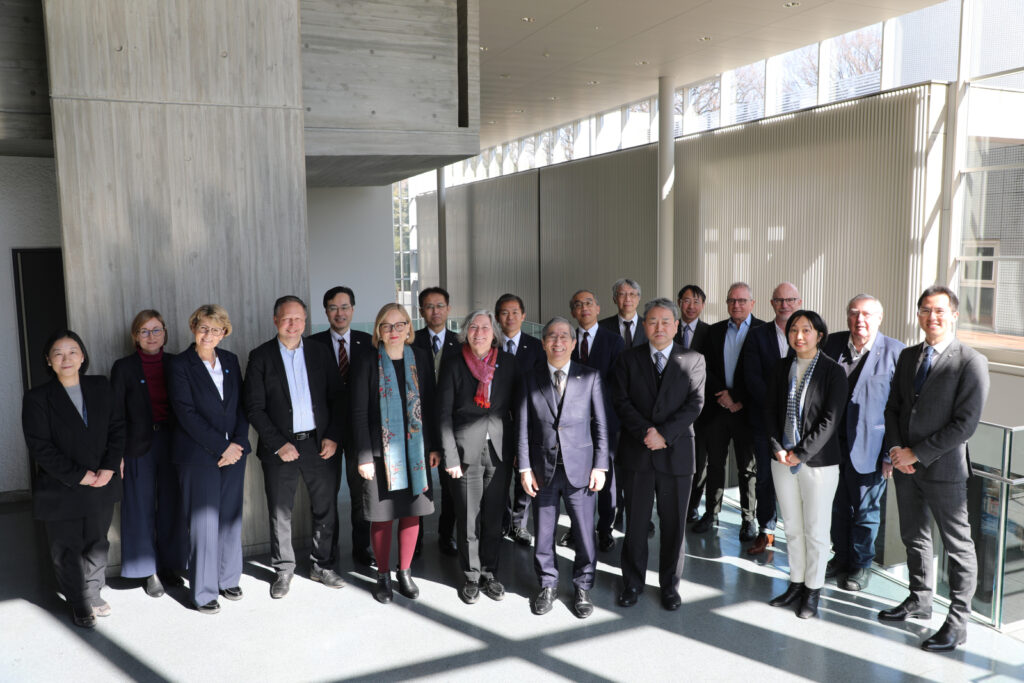
The University of Freiburg is Nagoya University’s oldest and closest partner in Europe. In November 2023, the two universities formalized this relationship at the highest level: Nagoya University designated Freiburg as its strategic partner in Europe, and Freiburg reciprocally designated Nagoya University as its enhanced partner in Asia. This mutual commitment rests on more than fifty years of trust and collaboration, and today finds its clearest expression in the Nagoya University Global Campus at the University of Freiburg, opened in June 2026.
Over fifty years of collaboration
The partnership traces its origins to 1972, when the two universities’ Schools of Economics began working together — the start of a relationship that has deepened steadily ever since. In 2010, Nagoya University established its European Center in Freiburg, hosted within the Freiburg Institute for Advanced Studies (FRIAS). Building on this base, FRIAS and Nagoya University’s Institute for Advanced Research carried out successive rounds of joint research projects, producing co-authored publications across physics, economics, law and chemistry — the scholarly foundation on which the strategic partnership was later built.
From European Center to Global Campus
The relationship took a decisive step forward under Nagoya University’s “Global Multi-Campus” international strategy. In June 2026, Rector Kerstin Krieglstein and President Naoshi Sugiyama inaugurated Nagoya University Global Campus at the University of Freiburg — a permanent base where students and researchers from both universities can meet, study and publish together, not as visitors but as members of a single, shared academic community.
Shared research priorities
Nagoya and Freiburg are drawn together by complementary strengths and a shared sense of purpose. Sustainability research is a major focus at both universities and sits at the heart of the partnership, alongside collaboration in medicine, the humanities and the natural sciences. Recent joint work has ranged from the circular economy to a Joint Degree Programme in Medicine, renewed in 2026 to educate the next generation of physicians and medical researchers across the two institutions.
Further information:
- Nagoya University — Nagoya University signs new Strategic Partnership Agreement with the University of Freiburg (November 2023)
- University of Freiburg — The University of Freiburg and Nagoya University agree on a joint doctoral programme (June 2026): the opening of the Global Campus and the renewal of the joint degree programme
- Nagoya University Global Multi-Campus Institute (GMC) — Nagoya University’s international multi-campus strategy

